
Translation: Hong Sangsoo, Composer
A translation of a recent short piece on Hong's work as a composer published in Cahiers du Cinema

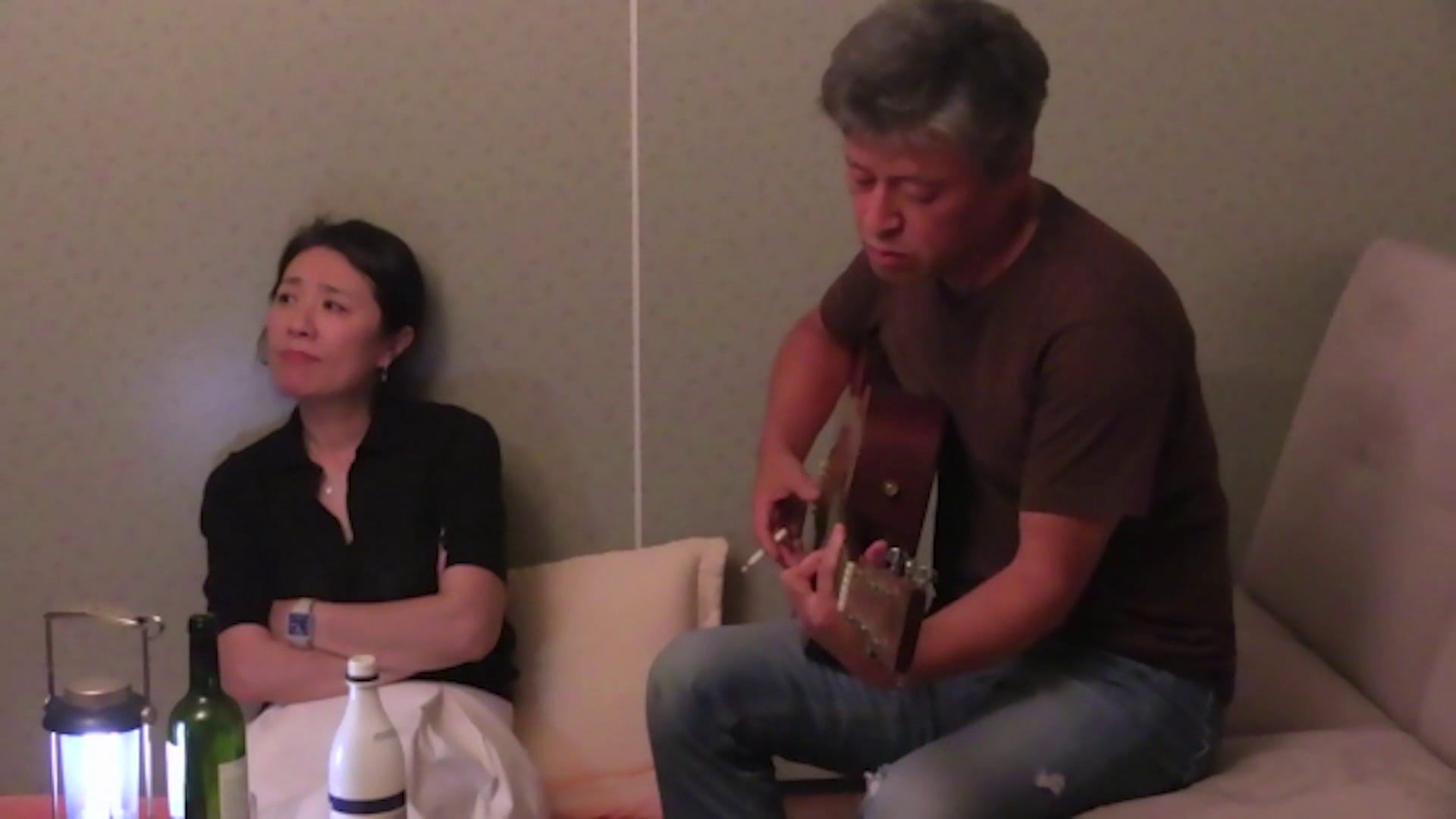
This short text was written as part of a feature called “Duos prodigieux” which described famous collaborations between directors and composers. Other pairings featured in the text include Johnny Greenwood/Paul Thomas Anderson and Alberto Iglesias/Pedro Almodovar.
Hong Sangsoo and Hong Sangsoo
Written by Romain Lefebvre
After having long collaborated with Jeong Yongjin and Dalpalan (Cahiers no. 731), Hong Sangsoo has become his own composer since The Woman Who Ran (2020), continuing along a path that combines formal minimalism, a principle of economy, and a penchant for amateurism. Music is, first and foremost, a hobby: the tunes that enter his films are those he composes on a daily basis, the filmmaker-orchestra alternating between guitar and synthesizer. Compared to certain refrains that once stood out as distinctive traits of his cinema, the current pieces have likely lost some sophistication. In a sonic equivalent of the blur, even the recording quality borders on professional misconduct: Hong Sangsoo uses, as-is, files stored on his phone - the playing of a song from a mobile at the end of In Water (2023) offers a mise en abyme of this lo-fi dilettantism.
Increasingly unconcerned with mastery, Hong Sangsoo’s use of music has not fundamentally changed. The tones can be soft, almost neutral, like the guitar melodies punctuating parts of Introduction (2021) and Walk Up (2022), or broader and warmer, like the synth theme framing In Our Day (2023). This intuitive approach, irreducible to any fixed system, stems from a very specific concern: rather than composing music expressly for a film, he tends to "stick" preexisting pieces onto it. Hong Sangsoo conceives of music with a certain autonomy and also avoids overly marked emotional effects. The aim is neither to underscore an emotion already rooted in a situation nor to suppress it, but rather, following an impressionistic logic, to highlight an atmospheric touch, suspended above the image like clouds above the earth.
To the music of the films, one must add the music within the films. While her friend Ingeok plays the keyboard in A Traveler’s Needs (2024), Iris urges him to resist the temptation of memory and to respond to each note with his whole being. This character's warning against indulging in self-centered sentiment echoes the filmmaker’s own distrust of emotional clichés.
In a conversation tinged with seductive intent and a morbid revelation, the light guitar tune played by Songak in In Front of Your Face (2021), with its awkwardly spaced notes, heightens the attention given to the present moment. For Hong Sangsoo, music is a pastime through which, if one opens up to the fullness of the moment, one may escape both memory and the looming prospect of disappearance.
Grass (2018) is an exception that also makes certain principles more palpable. In this film, the director uses classical pieces whose duration often matches that of the conversations, resulting in an overlap where the emotional registers of the music and those of the characters meet, contaminate one another as much as they clash. This logic is pushed to its limit in a scene where, while discussing a friend’s suicide, a man and a woman sink into an abyss of bitterness and sadness. Suddenly, an American folk song, “Oh! Susanna,” appears, arranged with childlike tones and carried by a recorder. A disconcerting contrast, it prevents us from sinking with the characters by creating a complex emotional blend at the intersection of image and sound. If this choice is ironic or cruel, it is so in the way life itself can be: like a sunny day when tears are falling.
“Hong Sangsoo et Hong Sangsoo” was originally published in Cahiers du Cinéma No. 822. Translation by Jhon Hernandez.